Research Synergies Workshop – 17 June 2026

UK-HyRES and HI-ACT join forces to shape the next generation of hydrogen research
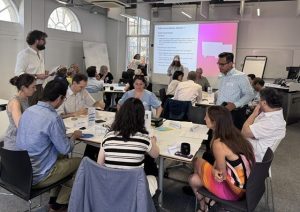
Researchers from UK-HyRES and HI-ACT came together at University College London for a dedicated Research Synergies Workshop, exploring how the two EPSRC-funded hydrogen research hubs can work together to tackle some of the UK’s biggest energy challenges.
The workshop brought together experts in hydrogen technologies, whole-energy-system modelling, safety, resilience and social science. It aimed to identify opportunities for collaboration that could create greater impact than either hub could achieve independently. Through facilitated discussions and collaborative design sprints, participants developed a series of research propositions that will now move into the next stage of development.
Building stronger connections across the hydrogen ecosystem
The workshop highlighted the complementary strengths of the two hubs. While UK-HyRES focuses on advancing hydrogen and alternative fuel technologies, HI-ACT brings expertise in whole-system integration, infrastructure, markets and policy. Together, these capabilities create new opportunities to accelerate the transition from research to real-world implementation.
Throughout the day, participants explored opportunities spanning hydrogen production and storage, transport and industrial applications, environment and society, digitalisation and data. Discussions centred on a shared ambition: connecting fundamental technology innovation with the wider systems, policy and societal considerations needed to enable hydrogen deployment at scale.
Three collaborative research opportunities
The collaborative sessions generated three emerging research propositions that will now be refined by researchers from both hubs.
Embedding safety and resilience from the start
A second proposition centres on developing a safety and resilience by design framework for future hydrogen and energy systems.
The proposed framework would help designers, manufacturers and decision-makers incorporate safety, resilience, supply chain dependencies and societal considerations during the earliest stages of system design, rather than addressing them retrospectively. It would also bring together technical, social and economic perspectives to help identify vulnerabilities, understand trade-offs and support responsible innovation.
Connecting technology innovation with deployment
The first proposition focuses on ensuring hydrogen technologies are developed alongside the systems, manufacturing capabilities and supply chains needed for successful deployment.
Rather than asking simply which technology performs best, researchers explored how technology design, manufacturing readiness and supply chain development can be considered together from the outset. By co-designing technologies with the systems they will operate within, the collaboration aims to support hydrogen solutions that are scalable, resilient and economically viable.
Integrating technology and whole-system modelling
The third proposition explores creating an integrated modelling capability that links detailed technology research with whole-system energy modelling.
By combining UK-HyRES’ expertise in hydrogen technologies with HI-ACT’s whole-system analysis, researchers aim to develop tools capable of understanding how hydrogen production, storage and end-use interact across industrial systems, transport networks and energy hubs such as ports. The resulting evidence could help guide future technology development, infrastructure planning and policy decisions while supporting industry investment.
Next steps
The Hubs are following up the Research Synergies Workshop by running focused, sprint workshops to develop each of the three propositions collaboratively, bringing in additional partners, and resource planning for the new research.